Waiting for Someone Who May Never Come
This is a bonus Patio Pondering on a Sunday afternoon. I am actually writing this from the patio after eating lunch while watching the radar and waiting for today’s “popup” rain. Most of this weekend my thoughts have gone back to a side trip I made after working with some of my Chinese clients in Chicago, a side trip I did not plan but had me anxious as I drove across Chicago last Friday morning.
As some of you know I am an advanced novice genealogist, my family tree has almost 7,000 people in it. I am past the “who is your grandmother” stage and into the dead ends in Aixheim, Wurttemberg, why did they leave Sulzfeld, Baden, and was he really a captain in the English Army phase. My searches regularly end in brick walls or revelations of facts I already have in my records. Many of my searches now are punctuated with more “why’s” coming from facts.
Now back to Chicago. You better tighten your seatbelt; this could be a bumpy ride back to the 19th century.
In the 1980s my grandmother corresponded with Forest Home Cemetery, formerly Waldheim, to get lots for burial of several Hagenbucher relatives, including my great-great-grandparents. She shared those letters with her family; I have my own copies. Since I was already in Chicago, I made the trip to Forest Home with nothing more than lot numbers and unknown expectations.
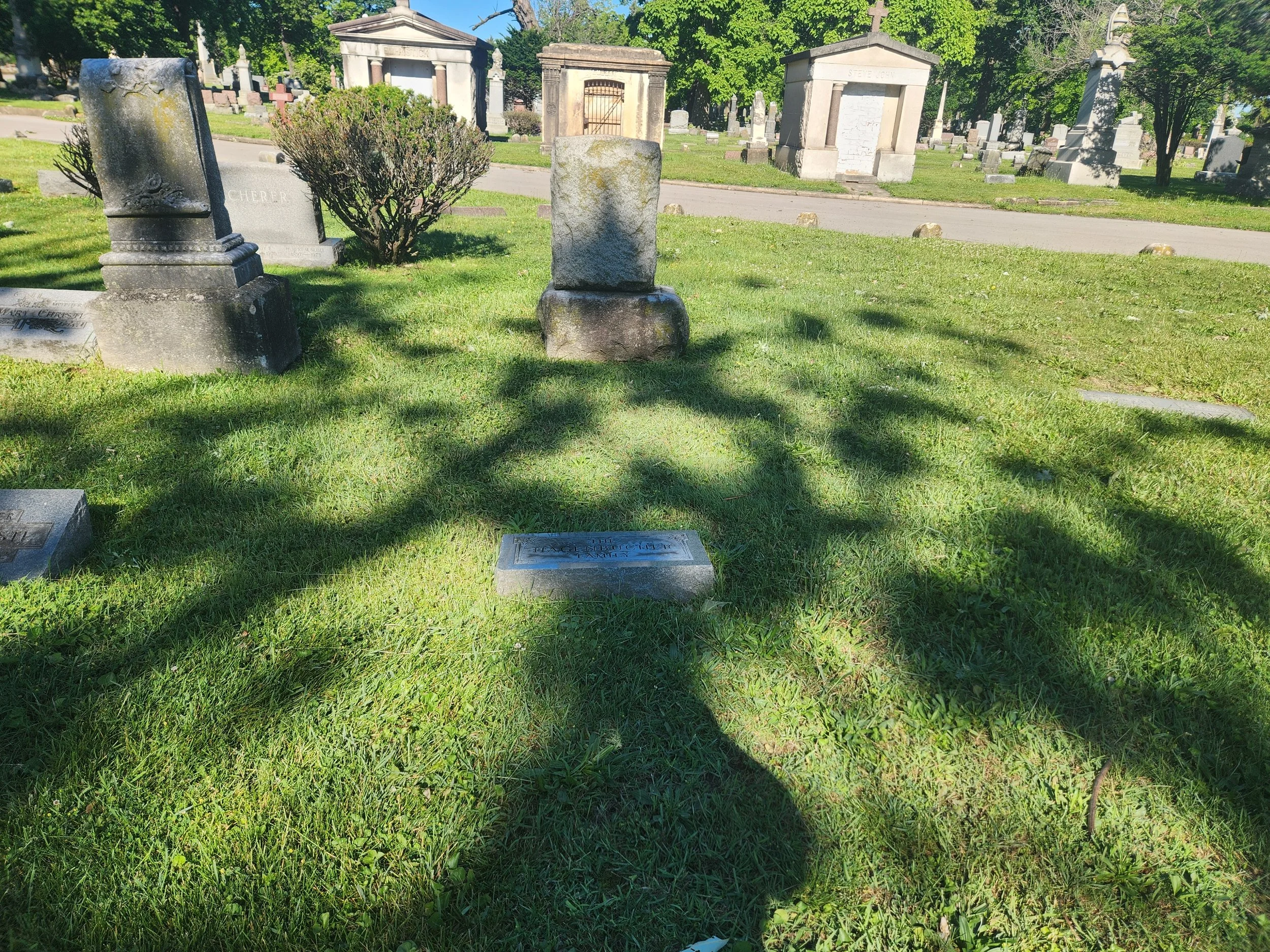
I found the plot in Section N where my great-great-grandparents Hagenbucher and step great-great-grandmother were buried and I was crestfallen. The three plots where my ancestors who braved the trip from Baden to the United States to build a life were marked with only a small marble marker engraved simply with “The Hagenbucher Family.”
Nothing for Tobias.
Nothing for Karolina the elder.
Nothing for Karolina the younger.
The Hagenbuchers are my great-great-grandparents on my paternal side (my grandmother Smith’s grandparents.) They emigrated from Baden, a part of the newly formed German Empire, to the United States in 1882. They were just six of the many that made up the great wave of Germanic people escaping economic and social challenges.
In Baden, Tobias and Karolina the elder knew each other from a young age, they had to since they were first cousins; their fathers were brothers. They were baptized as Lutherans in Sulzfeld Baden, a small village in what is now southwest Germany. After their marriage in 1874 they had four children: Caroline, Rose (my great-grandmother), Louis, and Louise. Two years after the birth of the youngest child they left their small village and traveled to the United States on the ship Price Frederick Wilhelm, arriving in New York on April 30, 1882.
Regardless of the family legend that Tobias attended Heidelberg University with Kaiser Bismarck, the fact remains that he was a gardener and not the eldest son. As one of my German cousins said “Hagenbuchers were poor farmers, there’s no way any of them attended university.” He would inherit nothing and his work as a gardener would not be high paying. This statement gives me insight as to why the young Hagenbucher family left Baden.
After moving to Chicago, Tobias and Karolina the elder opened a Confectionery and Milk Depot at 72 Canalport St. in Chicago. This is where Tobias built the massive forearms my grandmother mentioned, carrying 100 plus pound milk jugs every morning. I know little of this store other than a photo recently shared with me of Karolina and her children gathered on the front steps around 1890.
In my grandmother’s reminiscence she tells that Tobias was a member of the Turn Verein Vorwaerts along with a singing group that performed at the 1892 Chicago World’s Fair. I found online Tobias’ naturalization documents as well as his voter registrations and voting records. This was not just a man existing in his new life in Chicago, he was involved as a contributing member of society.
As with so many families in the not-so-distant past, tragedy struck when Karolina the elder died in November of 1890. I can find no records of her death outside of burial records and an official death announcement listing Ph Young as the funeral home and Waldheim as the interment site. Nothing else.
Charged with running a store and milk depot, meeting milk transports every morning, Tobias sent to Germany for help, Karoline Himmel left Sulzfeld and moved to Chicago. Not only was Karolina Himmel the now-deceased Karolina the elder’s niece, she was also Tobias’s first cousin once removed. Tobias and Karolina Himmel married in just five months after the death of Karolina the elder. My family stories say they tried to have children but all pregnancies ended without living children.
Tobias and Karolina the younger continued the store and milk depot until the early 1900s when they moved to Northwest Indiana and owned and operated an almost 150-acre farm in St. John, Indiana. Karolina the younger died in 1934 and Tobias in 1937 as a patient at the Elgin State Hospital in Elgin, Illinois. Another why for me: How did he get from St. John, Indiana to Elgin, Illinois?
I have searched for more information on these ancestors, I cannot find church records in Chicago, no obituaries for any of them, just an official death record for Karolina the elder from 1890. I am left with two pages of information written by my grandmother along with four letters from Forest Home Cemetery with vital and burial records.
Now back to my side trip in Chicago last week.
I stood a short distance from the family headstone trying to imagine the scenes from so many years ago when each of my three ancestors were interred, trying to imagine the mourners in attendance, the weather, the memories they were sharing with others and trying to imagine the cemetery as a new resting place without the wear and tear of years of weather and unintended neglect. I stood there trying to imagine my twenty-four-year-old grandmother as one of the mourners even though she never mentioned in her writing she attended.
I am also thinking about the forgottenness of these ancestors. Their headstone is not level and there were no signs of any memorials, just a plain gray stone sitting akimbo in the green grass. Nothing to signify the struggles, joys, love, successes and failures of these three people.
The fact that Tobias was a business owner, politically active, and a member of at least two German societies makes the question of why there is no headstone for him and his wives separately stronger.
What happened?
How do my ancestors who crossed an ocean, built a business, raised a family, became citizens, voted, joined civic organizations, and helped build a city end up remembered by nothing more than a small family marker?
I sit here on the patio as the rain falls on this cloudy Sunday lamenting that the lives of my great-great-grandparents are marked only by a simple family headstone. No larger, personalized memorial to the hard life they lived or their legacy. How many stories and legacies get neglected like that headstone in Chicago, sitting there unlevel, waiting for someone who may never come?